Christmas lights on trees and bushes: wraps, light counts and costs
Lighting trees for Christmas comes down to five looks: wrap the trunk, wrap the trunk and the main branches, drape the canopy, spiral an evergreen from the outside, or throw a net over a shrub. Bare deciduous trees look best wrapped, big evergreens look best spiraled or draped, and shrubs look best under a net.
For scale: a 25- to 30-foot maple with four main branches takes 90 to 110 lights at the 24-inch spacing of our permanent Diamond Tree Wrap. Seasonal and permanent tree lighting are both quoted at the measure. Below: the light-count math, the tree-safe way to hang them, and how we light trees if you'd rather hire it out.
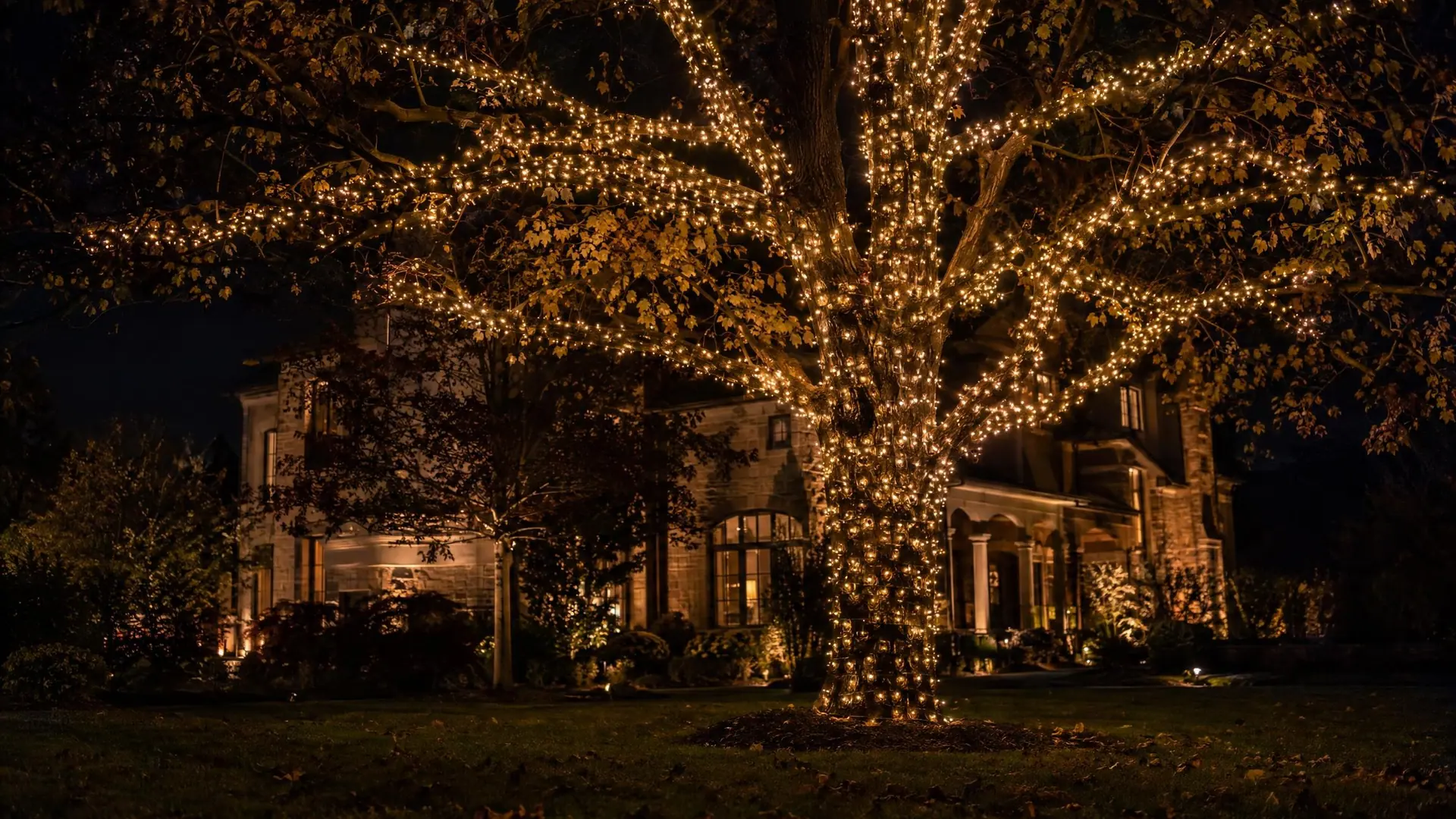
Pick the look: five ways to light a tree or shrub
Each look suits a different kind of plant, and the one you pick decides how many lights you need, how high you have to reach and how long it takes.
| Look | What it is | Best on | Trade-off |
|---|---|---|---|
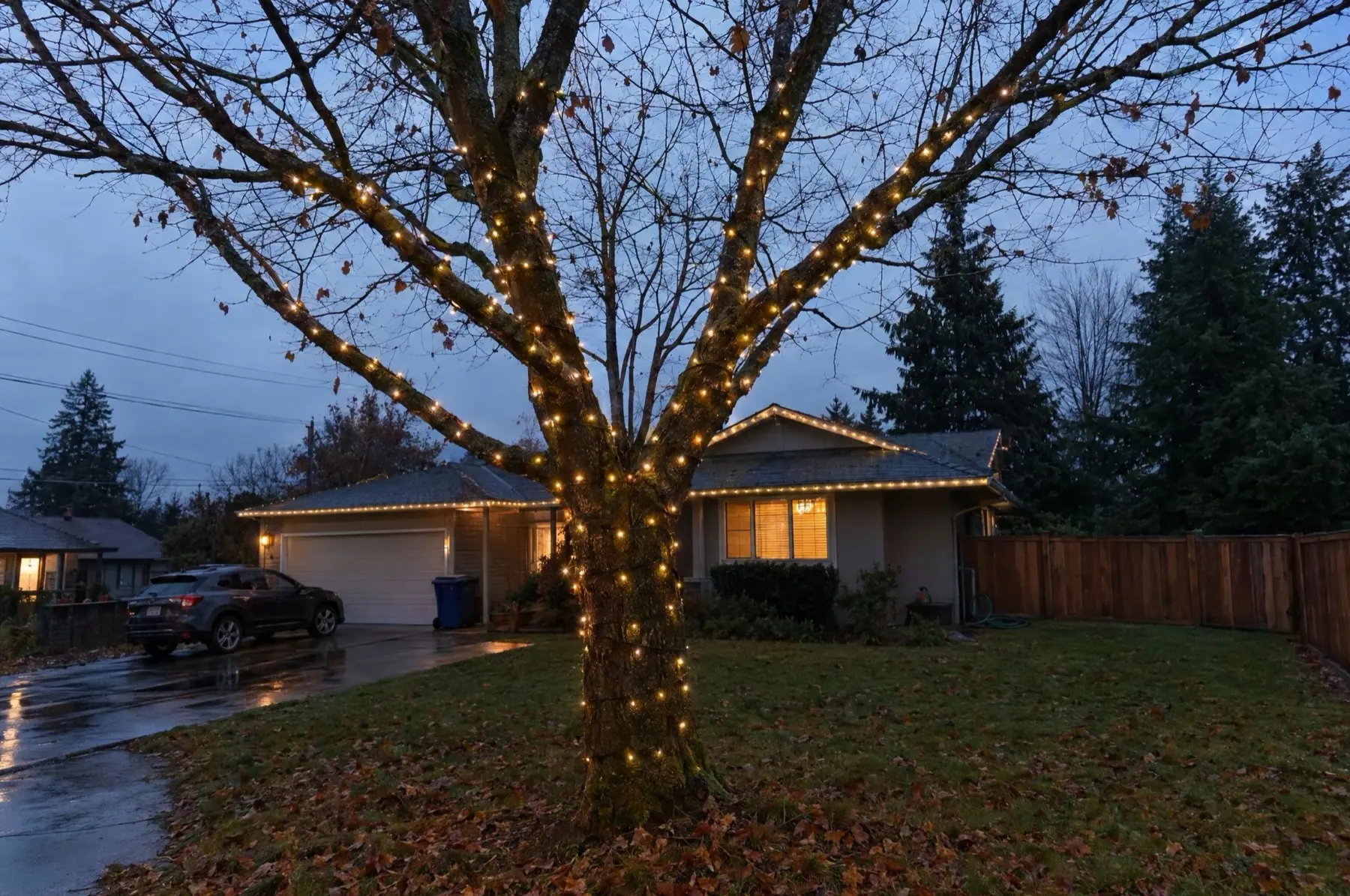
| Trunk wrap | Lights spiraled up the trunk to the first branches | Deciduous trees with a clear trunk | Quickest; reads as a glowing column |
| Trunk and branch wrap | The spiral carries on out the main branches, usually 3 to 4 feet | Maples, oaks, birches and other trees that are bare in winter | The best show per tree, and the most lights and ladder time |
| Canopy drape | Strands laid over the outer branches instead of wound around them | Big, full trees you can't wrap | Fast from a pole or lift; nothing circles a branch |
| Evergreen spiral | C7 or C9 bulbs wound around the outside of the cone, bottom to top | Firs, spruces and pines | Big bulbs read from the street; tall trees need a lift |
| Net lights | A ready-made grid of mini lights draped over the plant | Round and square shrubs, hedges | Even coverage in minutes; nothing to wrap |
Deciduous trees, evergreens and hedges: which look suits which
- Deciduous trees such as maples, oaks, birches and dogwoods are bare through the holidays, so the branch structure is the display. Wrap the trunk and a few strong, well-spaced branches rather than every limb. A lighting retailer's calculator puts about 8 inches between bulbs as the ideal for them.
- Evergreens such as firs, spruces, pines and cedars hide a wrapped trunk behind their needles, so light the outside instead: spiral bulbs around the cone or drape the outer branches. The same retailer says C7 and C9 bulbs are the most popular choice on larger evergreens, and that lighting the canopy gets you brightness without climbing to the top. For a permanent wrap on a fir, we spiral the trunk and run lights along the lowest tiers.
- Young or newly planted trees are the ones to leave alone. Davey Tree's arborists say to avoid draping new or young trees, and NDSU Extension singles out trees planted in the last few years as the ones to check for leftover wires and ties.
- Hedges and shrubs take net lights, or strands tucked into the outer foliage. They're the easiest part of a display to do yourself, and they have their own section below.
- Trees near power lines come with one rule: look up before you climb, raise a pole or lean a ladder. Clark Public Utilities tells customers to look for lines before climbing a tree and to call the utility to have a tree trimmed away from lines that run through it.
How many lights a tree takes
Measure three things: the trunk's circumference (wrap a string around it, then measure the string), the height you'll wrap to, and the gap you want between wraps. Then:
- Turns = height ÷ gap between wraps.
- Feet of lit string = turns × circumference. Work out each branch the same way and add them up.
- Lights = feet of lit string ÷ bulb spacing.
| Tree | What's lit | Gap and spacing | Lit length | Lights |
|---|---|---|---|---|
| Deciduous tree, trunk 3 ft around | Trunk to 8 ft | Wraps 4 in. apart, a bulb every 6 in. | 72 ft | 144 |
| Maple, 25 to 30 ft tall, four main branches | Trunk and branches, permanent wrap | A diamond light every 24 in. | 180–220 ft | 90–110 |
| Fir, 20 ft tall, 12 ft across at the base | Outside spiral, bottom to top | Turns 18 in. apart, a C9 every 12 in. | ≈250 ft | ≈250 |
The first and third rows are the formula worked through. For a cone-shaped evergreen, use half the base circumference as the average turn: 3.14 × 12 ft ÷ 2 ≈ 18.8 ft, times 13.3 turns. The maple is our standard planning example for a permanent wrap.
Rather have the trees counted and priced along with the house? Call or text (360) 369-0936
How to wrap a tree with Christmas lights, step by step
For a seasonal wrap with string lights:
- Test every set on the ground, then wind each one into a ball so it unrolls as you walk it around the trunk.
- Start at the base, with the plug end on the side nearest the outlet.
- Wrap upward and keep the gap between wraps even. Snug enough that it won't slide, never cinched tight.
- At each branch you've picked, wrap out 3 to 4 feet with a wider gap, come back down filling in between, and cross to the next branch at its base.
- Plug each new set into the last one as you go, up to the connected-set limit printed on the package. Past that, start a new run on its own cord.
- Tuck the last bulb under a wrap instead of zip-tying it, so nothing is left behind to girdle the branch.
- Set a timer to switch the tree off at bedtime.
Protecting the tree: loose wraps, no hardware and a date to take them down
Lights don't hurt a tree; what's left around it does. NDSU Extension's tree specialists warn that any wire, strap, zip tie, cable or rope left circling a trunk or branch will eventually girdle it, whether that takes two years or twenty, and they count the ties that hold Christmas lights in that list.
Davey Tree's arborists say the same about lights left up year-round: laying lights over branches can be fine, but wrapping around a branch, spirals included, will eventually girdle it.
- Nothing goes into the bark: no nails, screws or staples.
- Wrap loosely, with room to spare. Never cinch a strand around a branch.
- Take seasonal lights down, ties included, before spring growth. Our seasonal takedowns run January 2–15.
- Put tree lights on a timer that ends at bedtime. The CPSC's decorating tips say to switch tree lights off when you go to bed or leave the house.
- A year-round wrap needs its tension checked every year as the trunk and limbs thicken. Ours go on loose with no hardware in the tree; ask at the measure how that yearly check is handled.
Power, rain and outlets
Outdoor tree lights sit at the wet end of the extension cord. In a normal November, Vancouver gets measurable rain on about 19 days (NOAA's 1991–2020 normals), so treat every connection as if it will be rained on.
- Use lights and cords labeled for outdoor use. The CPSC and UL add that on most decorative sets sold in stores, UL's red holographic label means indoor and outdoor use, and the green one means indoor only.
- Plug into a GFCI-protected outdoor outlet or a portable GFCI. A GFCI cuts the power when there's a ground fault, which can happen when equipment gets wet.
- Check the connected-set limit before plugging strands end to end. The CPSC's rule for incandescent sets is never more than three; LED sets allow more, and the limit printed on the package is the one that counts.
- Keep plugs and connections off the ground. A lighting retailer's advice for hedges is a foot of clearance, so nothing sits in water or snow. The same rules hold on the roofline: see how to hang Christmas lights on your house.
- Never cut, splice or re-plug a strand, and don't add an outlet yourself. In Washington, L&I says custom cut-to-fit lighting takes a licensed electrical contractor, with permits and inspections, while unaltered off-the-shelf sets don't. A new outdoor outlet is an electrician's job.
Seasonal tree lighting vs a permanent Diamond Tree Wrap
Hiring a tree lighting service instead of climbing? We light trees two ways.
Seasonal. Our seasonal service is built around the roofline: commercial Wintergreen C9s, with January takedown and storage included in year one. Trees are quoted at the measure, because two trees of the same height can take very different amounts of light. Tell us which trees when you book and they're priced with the rest of the house.
Permanent. The Diamond Tree Wrap stays up all year and runs from the same app as a roofline: warm white most nights, orange for Halloween, red and green in December. It uses Minleon's RGBW+2 diamond pixel, a 360-degree light that Minleon's datasheet lists as IP66, UL listed and rated from -4°F to 122°F, on a black cord with a light every 24 inches.
We charge by the foot: simple, honest, no hidden fees. Your written quote spells out everything before any work starts. For a tree wrap, the feet are the wrap path, with a light every 24 inches, and we measure it at the visit, trunk and branch by branch. Added to a roofline package it shares the roofline controller; on its own it needs its own controller, quoted as a system line. Trees over 20 feet need a lift, quoted up front. More on how we wrap: permanent tree wrapping.
Want your trees measured and quoted with the house? Book a free estimate
Rather talk your trees through with someone? Call or text (360) 369-0936
Sources [14]
One moment…
Checking availability.
Bushes and hedges: nets, strands and where the plug goes
Shrubs are the easiest part of a display to do yourself: nothing needs a ladder, and net lights do most of the work. Net lights aren't part of our published seasonal package; if you want shrubs lit along with the roofline, mention them when you book and we'll tell you at the measure whether we can include them.
- Size the net to the shrub. A lighting retailer's sizing: a 4-by-6-foot net covers a shrub up to about 3 feet tall and 3 feet wide. Go to 4 by 8, or join nets end to end, for bigger plants, and size up when in doubt, because a net that's too small won't reach the sides.
- Square or boxy shrubs: start at a corner and drape the net the way you'd wrap a present.
- Round and cone-shaped shrubs: turn the net vertical and hang overlapping panels around the plant, so the lights don't bunch at the top.
- Hedges: lay the nets side by side on the ground first, all facing the same way, then lift them on without overlapping the seams.
- Strands instead of nets: tuck them into the outer foliage in a random pattern, covering the top and about three-quarters of the way down the sides.
- Power: hold each net so its plug sits at the bottom corner nearest the outlet, bring power to the middle of a long hedge and run lights both ways, and keep connections a foot off the ground.
Packages mentioned
- Diamond Tree Wrap — 360-degree diamond lights spiraled up trunks and branches.
Priced by the foot · No hidden fees
Read next
- Where to Put Permanent Christmas Lights on a House
- How to Hang Christmas Lights on Your House Like a Pro
- Christmas Light Installation Cost 2026: Vancouver & Portland
- Permanent vs Seasonal Christmas Lights: Cost Over Time
- Christmas light installation, with takedown and storage included
- How our pricing works
- Free estimate
Questions this guide gets
Do Christmas lights hurt trees?
How long can Christmas lights stay on a tree?
How many lights do I need for a tree?
Can you wrap a 40-foot fir?
What does it cost to have a tree lit?
Are net lights safe on bushes in the rain?
Sources
Outside facts on this page come from these sources, read on September 26, 2026.
- Christmas Lights, Etc.: How to wrap a tree with Christmas lights · lighting retailer, updated August 13, 2026
- Christmas Lights, Etc.: Christmas net lights for bushes · lighting retailer
- Davey Tree: Is it OK to keep outdoor tree lights on year round? · December 19, 2022
- Christmas Lights, Etc.: Christmas tree light calculator · lighting retailer, updated August 13, 2026
- NDSU Extension, Tree Information Center: Springtime spruces 1, girdling Christmas lights
- Clark Public Utilities: Be safe outside
- U.S. CPSC: Holiday decoration safety tips (publication 611, PDF)
- Purdue Extension, FNR-FAQ-17: Does night lighting harm trees? (PDF) · June 2002
- NOAA NCEI: U.S. climate normals 1991–2020, monthly, Vancouver 4 NNE, WA (USC00458773) · days with 0.01 inch or more of precipitation
- U.S. CPSC and UL: Holiday safety alert, 12 safety tips (release 12-054) · December 13, 2011
- Electrical Safety Foundation International: How to use GFCIs
- U.S. CPSC: Happy holidays start with safety (release 25-049) · November 19, 2024
- Washington L&I: Electrical Currents, December 2025 (PDF, page 2) · who can install seasonal and year-round lighting
- Minleon USA: RGBW+2 diamond pixel data sheet (PDF) · specifications as of August 2026