How to hang Christmas lights on your house: the installer's method, clip by clip
The best way to hang Christmas lights on a house: measure every run, buy factory-made strands that fit, clip every bulb on the ground, then hang from the outlet outward with the bulbs all at the same angle. Plug into a GFCI-protected outdoor outlet on a timer. No nails, no staples, no cutting.
It's the method behind our seasonal installs (a clip on every bulb, no staples or nails, a timer on every job), set out step by step below with the Northwest details that matter here: November rain, mossy roof edges and the east wind out of the Gorge. Rather not climb at all? Skip to what it costs to have them hung.
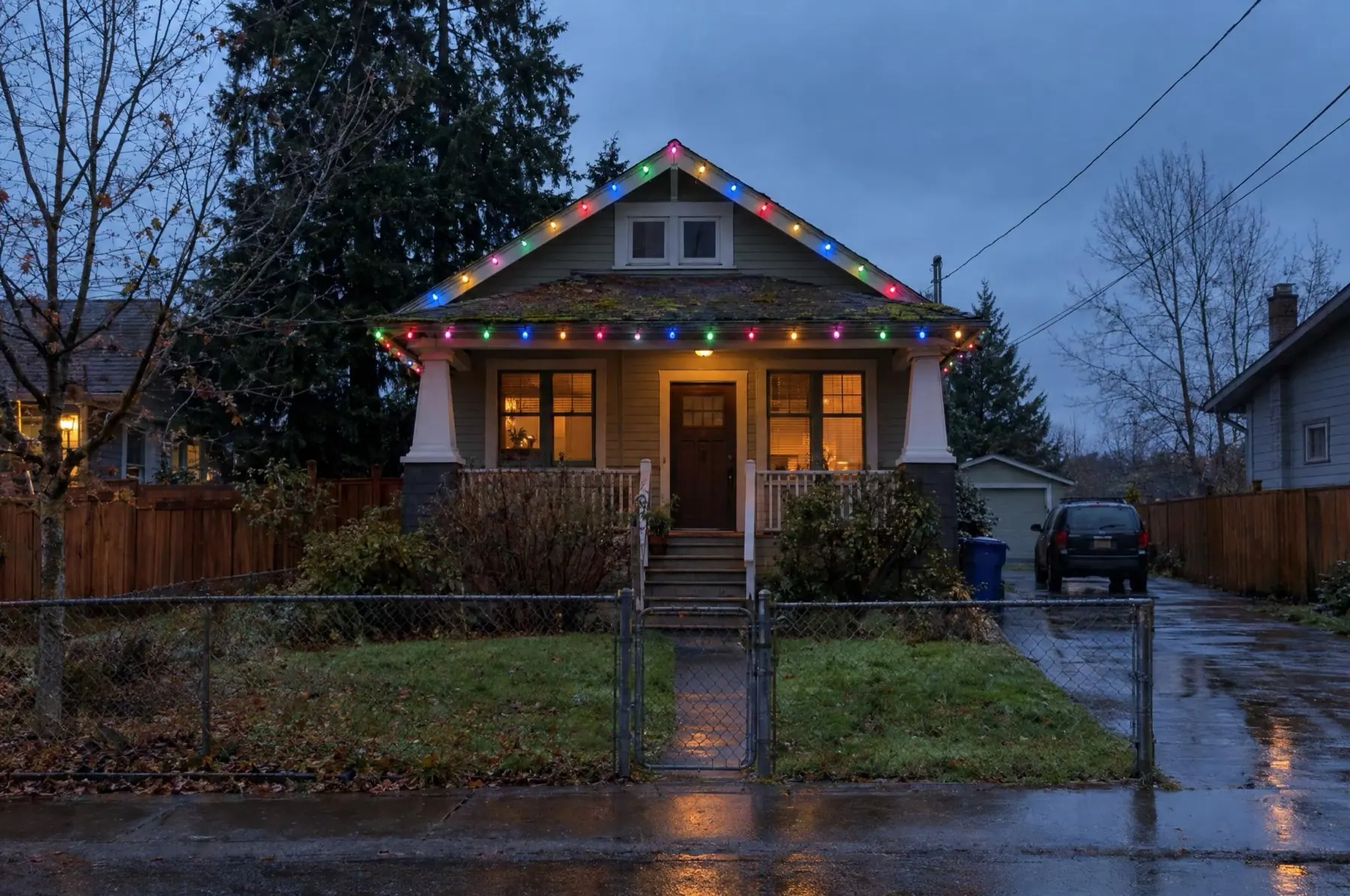
Before the ladder: measure, plan the power, buy strands that fit
Walk the house and measure every run you want lit: the eaves, the garage, the porch and each gable. Gables measure longer than they look, since each one is two sloped runs; a 24-foot-wide gable adds about 30 feet. A satellite measurement is a fine start, but tape the runs you'll actually hang.
Then plan the power. Find the outdoor outlet each run will start from and make sure it's GFCI protected: either it has its own TEST and RESET buttons, or it's covered by a GFCI outlet or breaker elsewhere, and pressing TEST there makes the outdoor outlet go dead. Lights run away from the plug, so the outlet decides where each run begins. Lighting trees and shrubs too? They have their own math: Christmas lights on trees and bushes.
Buy factory-made sets in lengths that cover each run, and never cut, splice or re-plug one to make it fit; tuck a little extra away at the end instead. In Washington, L&I treats custom cut-to-fit lighting as licensed electrical work, with permits and inspections, while unaltered off-the-shelf sets covered by UL 588 need no electrical license.
Check the connected-set limit before you buy. The CPSC says never to string more than three incandescent sets together. LED sets allow more, and the limit is printed on the package: one commercial C9 LED set we checked allows up to 432 watts end to end.
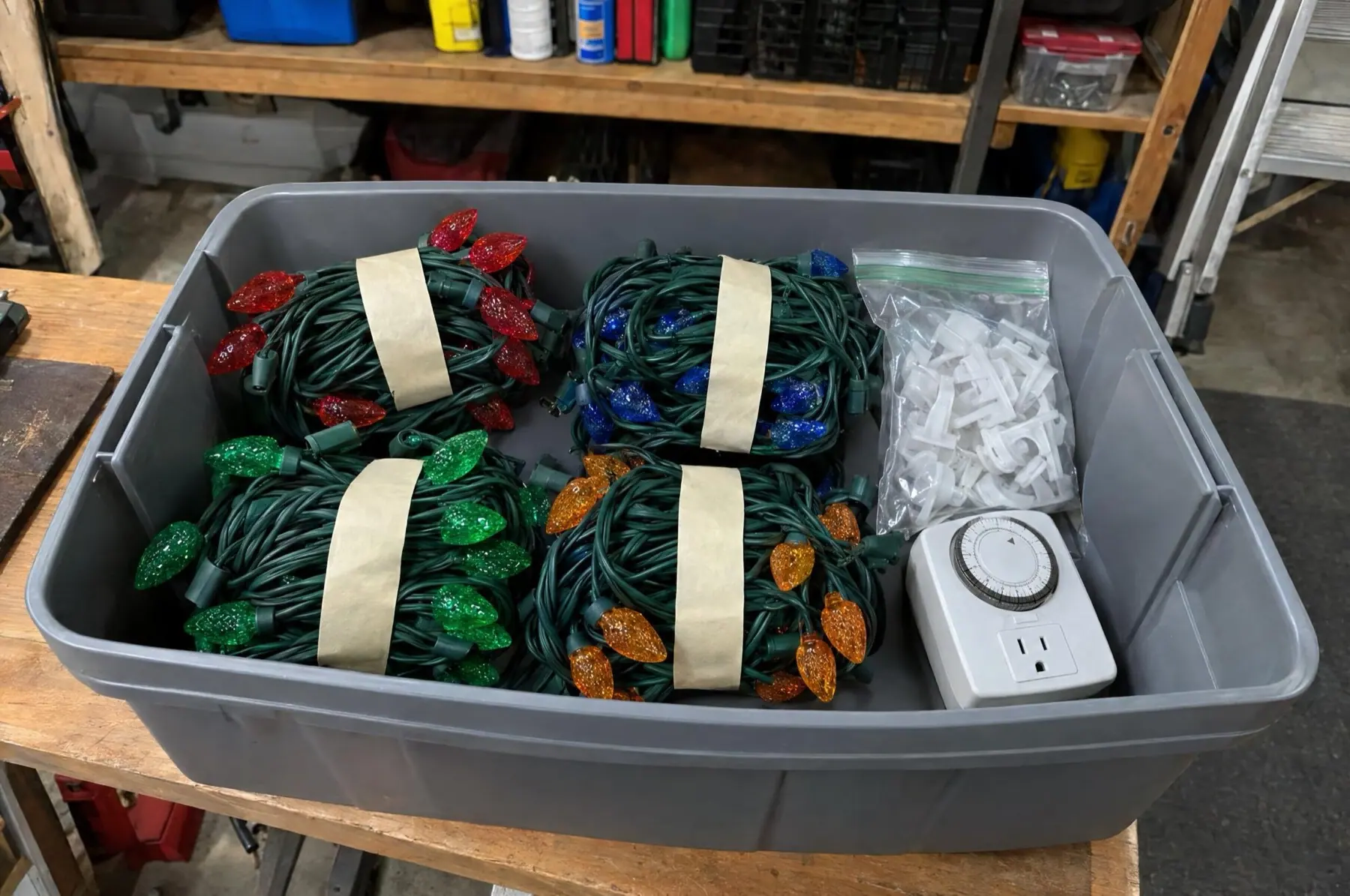
- Lights labeled for outdoor use. A 25-light C9 set at 12-inch spacing covers 25 feet.
- One clip per bulb, plus a few spares.
- An outdoor timer or smart plug.
- Extension cords rated for outdoor use and for the load.
- A ladder tall enough for the highest run (more on that below).
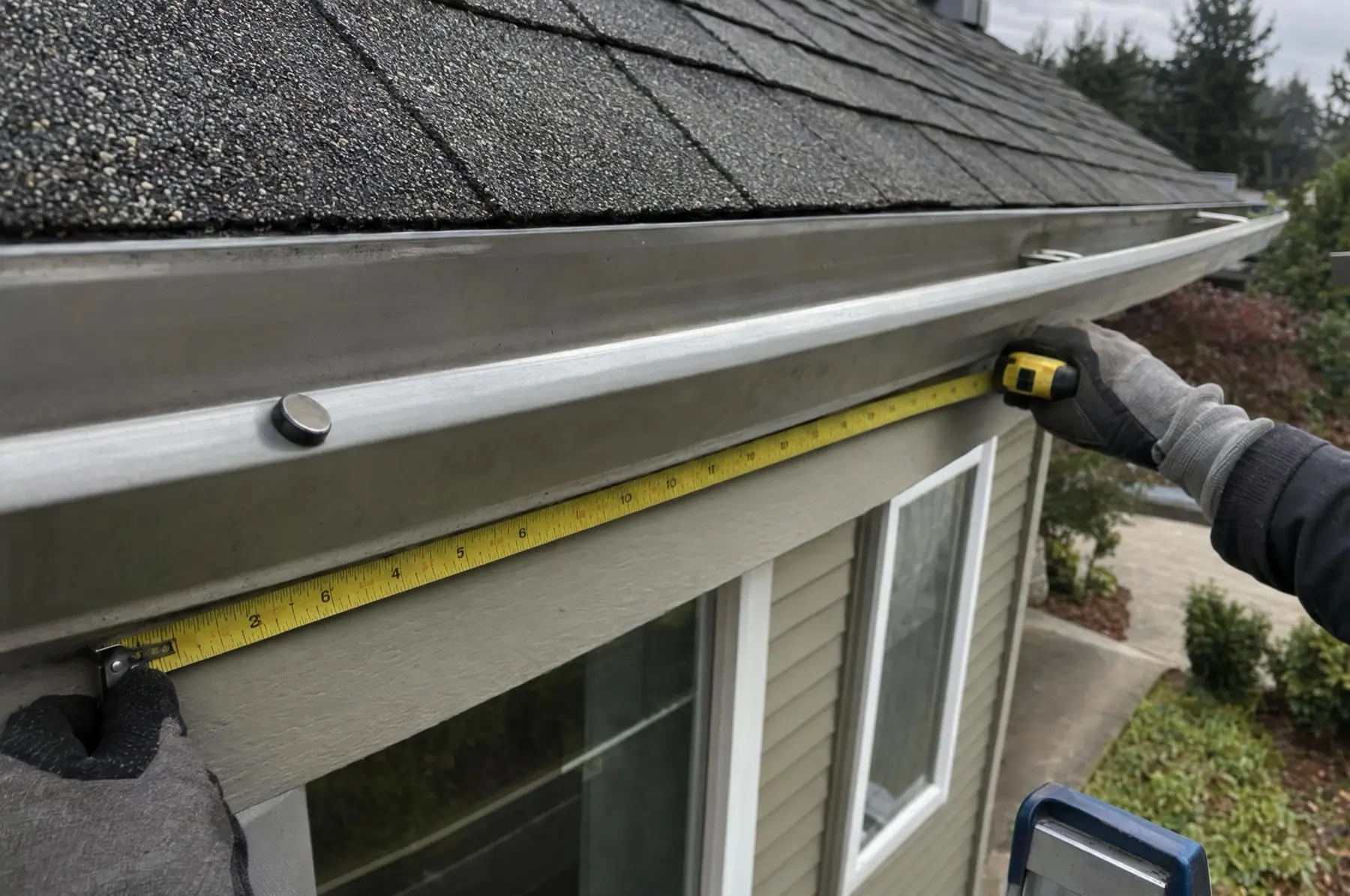
Want a written quote for your footage instead? Book a free estimate
Christmas light clips: the right one for gutters, shingles and metal
Clips are what make a roofline look professional: every bulb held at the same angle, nothing sagging, nothing punched through the gutter or shingles. A lighting retailer's clip guide opens by telling you to put away the staple gun and hammer, and it's right.
| Surface | Clip | How it sits | Notes |
|---|---|---|---|
| Gutter | All-in-one clip | Slides over the front lip, flat tab against the back; bulbs point straight out | Also holds mini and icicle lights |
| Shingle edge (eave or rake) | All-in-one clip or shingle tab | Tab slides under the first shingle; bulbs stand upright | Slide it in; don't lift the shingle |
| Gutter guard | Plastic clip on the gutter lip, or shingle clips | Depends on the guard; see the next section | Check the guard maker's warranty terms |
| Steel edge or metal roof | Magnetic clip | Holds on any metal a magnet sticks to, upright or straight out | Aluminum won't hold a magnet; test first |
Clip details from a lighting retailer's clip guide and product page; gutter-guard guidance from the guard makers.
Hanging the roofline, step by step
Installers hang a roofline in a set order, and most of the work happens on the ground.
- Test every set on the ground and replace any that won't light.
- Clip on the ground: snap a clip onto every bulb or socket, set for the surface it's going on (straight out for gutters, upright for shingles).
- Start at the outlet. Put the plug end at the power and hang away from it, so each set plugs into the one before.
- Set the ladder for the stretch in front of you, with its base out from the wall by a quarter of its extended length (1 foot for every 4 feet of ladder). Carry the strand on a tool belt or have it handed up, and keep your belt buckle between the rails. Climb down and move the ladder rather than reaching.
- Seat a clip at every bulb, all at the same angle, with the strand straight between clips and no loops or sags.
- At exposed corners, route the cord behind the drip edge so there's no loose loop for the wind to catch.
- Leave the extra at the far end, not the plug end, and tuck it behind the gutter or under the last shingle.
- Plug into the timer, set it for dusk to 11 pm, and look at the house from the street before the ladder goes away.
- Peaks. Hang a gable as one run, up one rake edge and down the other, starting on the side nearest the outlet. Clip every bulb on the slope so the line stays straight to the peak, and move the ladder rather than lean out to reach it.
- Wind. In the Gorge wind belt, fastening matters more. During an east-wind event in February 2026, KATU reported gusts over 60 mph at Corbett, with the National Weather Service expecting the strongest gusts from Washougal and Troutdale eastward, and the January 2009 storm pushed 50 to 60 mph gusts into Troutdale, Gresham and East Portland. The CPSC's tips put it in one line: fasten outdoor lights securely to protect them from wind. A clip on every bulb and no loose loops at the corners is how.
- Rain. Vancouver's normal November brings measurable rain on about 19 days, against about 14 in October (NOAA's 1991–2020 normals). Hang on a dry day, and don't work from a ladder onto a wet, frosty or mossy roof edge.
Christmas lights on gutter guards, and eaves with no gutters
Gutter guards change the clip, and the guard maker's rules come first, because some guards carry their own warranties.
- Hooded one-piece guards. LeafGuard's guidance is to use plastic clips that hang from, or slide over, the gutter's front crimped edge; never to hang lights from the hood itself, because that changes how the gutter works; and never to use metal hangers or tape, which void its finish warranty.
- Mesh and screen guards. LeafFilter suggests temporary shingle clips on the roof edge, which it says shouldn't void a roof warranty, or all-in-one clips holding C9s under the gutter, or adhesive clips made for the gutter surface.
- No gutters. Clip to the shingle edge instead: an all-in-one clip or shingle tab slides under the first course and holds each bulb upright along the eave.
- Steel drip edge or a metal roof. Magnetic clips hold on any metal a magnet sticks to. Aluminum drip edge, common on newer roofs, won't hold one, so test with a magnet first.
Two-story houses and roof peaks: when to stop
Most of the risk in holiday lighting is the ladder. The CPSC counts about 160 Christmas decorating injuries a day during the season, nearly half of them falls; in its 2023 holiday season (November 2022 through January 2023), about 14,900 people were treated in emergency rooms for holiday decorating injuries.
The American Ladder Institute's rules cover most of what goes wrong:
- Use a ladder long enough that you never stand above the highest standing level marked on its label. To step onto a roof, it has to reach 1 to 3 feet above the eave and be tied off at the top.
- Set the base out from the wall by a quarter of the ladder's extended length, on firm, level ground.
- Keep three points of contact and nothing in your hands; a tool belt, a helper or a line carries the lights up.
- Keep your belt buckle between the rails, and move the ladder rather than reach.
- No ladders in high winds or storms, and nothing slippery at the base or where the top rests.
One moment…
Checking availability.
No ladder: hanging lights from the ground
On a single-story eave, a light-hanging pole does the job from the ground. It grips a standard plastic clip; you slide the clip under a shingle or onto the gutter lip, then release it and move to the next bulb. LeafFilter's how-to notes it takes some trial and error. Pre-clip the whole strand first, and work from the outlet outward exactly as you would from a ladder.
Sources [9]
Power: outdoor outlets, GFCIs and timers
- Plug outdoor lights only into a GFCI-protected outlet or a portable GFCI, as the CPSC advises. The Electrical Safety Foundation lists outdoor receptacles among the places GFCIs are required.
- Test the GFCI before you plug in: press TEST and the power should go off; press RESET and it should come back. If either doesn't work, ESFI says the GFCI should be replaced, and that's an electrician's job.
- A GFCI shuts the power off when there's a ground fault, which can happen when equipment gets wet. If it trips in the rain, reset it once. If it trips again, unplug the lights and find the wet connection or damaged set rather than resetting over and over.
- Use extension cords rated for the job, and keep plug connections off the ground.
- Put everything on a timer set for dusk to 11 pm. The CPSC says to switch decorations off when you go to bed or leave the house, and a timer does it every night.
- No outdoor outlet where you need one? A new receptacle is licensed electrical work. ESFI's advice is to have a qualified electrician install GFCI protection where code requires it.
Taking them down without pulling on the gutters
Our seasonal takedowns run January 2–15. Doing it yourself, pick a dry day and reverse the install:
- Unplug everything at the outlet first.
- Unclip bulb by bulb from the ladder. Pulling a strand off from the ground drags every clip along the gutter lip or shingle edge.
- Leave the clips on the strand if you'll hang the same runs next year; it skips the slowest part of the job.
- Coil each run loosely or wind it on a reel, and label it with where it goes: garage eave, left gable, porch.
- Test before storing, and throw out any set with cracked sockets or frayed wire.
- Store the strands dry, in a closed bin.
Sources [5]
DIY vs hiring it out: time, risk and cost
Doing it yourself costs the lights, the clips, a timer and cords, plus two sessions on the ladder: up in the fall and down in January. Hiring it out costs more in the first year and none of your weekend.
- Cost. On average, Christmas lights run about $600; smaller homes often cost less, and the free measure gives your exact written quote. We charge by the foot: simple, honest, no hidden fees. Your written quote spells out everything before any work starts.
- Time. Our installers hang a 150-foot ranch in about two hours. Allow longer for a first DIY attempt, plus the January trip.
- Risk. The ladder, per the CPSC numbers above.
- The other route. If you're done with ladders for good, permanent lighting is installed once and stays up. On average, permanent lights run about $3,000; smaller homes often cost less, and the free measure gives your exact written quote. Permanent vs seasonal lights compares the two.
| What it takes | Doing it yourself | Our seasonal installation |
|---|---|---|
| Lights | Buy outdoor-rated sets and store them all year | Commercial-grade Wintergreen faceted C9 LED bulbs, one color of your choice |
| Clips | About $14 per 100 at retail (September 2026) | A clip on every bulb, no staples, no nails, no zip ties on gutters |
| Timer | Buy one and set it | Timer or smart plug set for dusk to 11pm |
| Ladder work | Two sessions: up in the fall, down in January | Installed October 15 to December 10. January takedown on the date agreed in your quote |
| Storage | Your garage | Testing, labeling and storage until next season |
| Price | Lights, clips, timer and cords, plus your time | Priced by the foot · No hidden fees. Later seasons are a re-hang of the same layout |
On average, Christmas lights run about $600; smaller homes often cost less, and the free measure gives your exact written quote.
Want a number for your house today? Call or text (360) 369-0936
Sources [7]
Read next
- Christmas Light Installation Cost 2026: Vancouver & Portland
- Christmas Lights on Trees and Bushes: How Pros Light Them
- C7 vs C9 Christmas Lights: Which to Use on Your Roofline
- LED vs Incandescent Christmas Lights: Cost to Run and Look
- Do Permanent Christmas Lights Survive PNW Rain and Wind?
- Permanent vs Seasonal Christmas Lights: Cost Over Time
- Christmas light installation, with takedown and storage included
- How our pricing works
- Free estimate
Questions this guide gets
Can I use nails or staples to hang Christmas lights?
How long does it take to hang Christmas lights?
Can you hang lights I already own?
When should I hang Christmas lights?
How do I hang Christmas lights on a two-story house?
What clips work with gutter guards?
Sources
Outside facts on this page come from these sources, read on September 26, 2026.
- Electrical Safety Foundation International: How to use GFCIs
- Washington L&I: Electrical Currents, December 2025 (PDF, page 2) · who can install seasonal and year-round lighting
- U.S. CPSC: Happy holidays start with safety (release 25-049) · November 19, 2024
- Commercial C9 LED set, 25 lights at 12-inch spacing (product page) · connect up to 432 watts end to end
- U.S. CPSC and UL: Holiday safety alert, 12 safety tips (release 12-054) · December 13, 2011
- Christmas Lights, Etc.: Christmas light clips guide · lighting retailer, updated January 28, 2026
- Wintergreen Lighting all-in-one Christmas light clip, 100 pack (product page) · $13.99 when checked September 26, 2026
- LeafGuard: Hanging Christmas lights on gutters
- LeafFilter: How to hang Christmas lights, 3 ways to make it easier
- American Ladder Institute: Extension ladders
- American Ladder Institute: Basic ladder safety
- KATU: Gusty winds expected Wednesday night into Thursday for areas near the gorge · February 4, 2026
- FOX 12 Weather Blog: 115 mph in Gorge today · January 20, 2014
- U.S. CPSC: Holiday decoration safety tips (publication 611, PDF)
- NOAA NCEI: U.S. climate normals 1991–2020, monthly, Vancouver 4 NNE, WA (USC00458773) · days with 0.01 inch or more of precipitation
- Clark Public Utilities: Be safe outside
- Portland General Electric: Outdoor safety