LED vs incandescent Christmas lights: cost to run, look and safety
A 150-foot roofline of incandescent C9 bulbs costs about $18.00 to run for 30 nights on Clark Public Utilities and $40.95 on PGE. The same roofline in LED C9s costs $2.06 and $4.68. An incandescent C9 draws 7 to 10 watts; an LED C9 draws less than one.
LEDs also stay cool and usually have plastic lenses instead of glass, and Wintergreen rates its LED C9 for 60,000 hours against 3,000 for its incandescent C9. Incandescents cost less up front, and many people still pick them for the classic look they grew up with. Below: the math on local rates with every assumption shown, how the two look, and what's safe on one outlet.
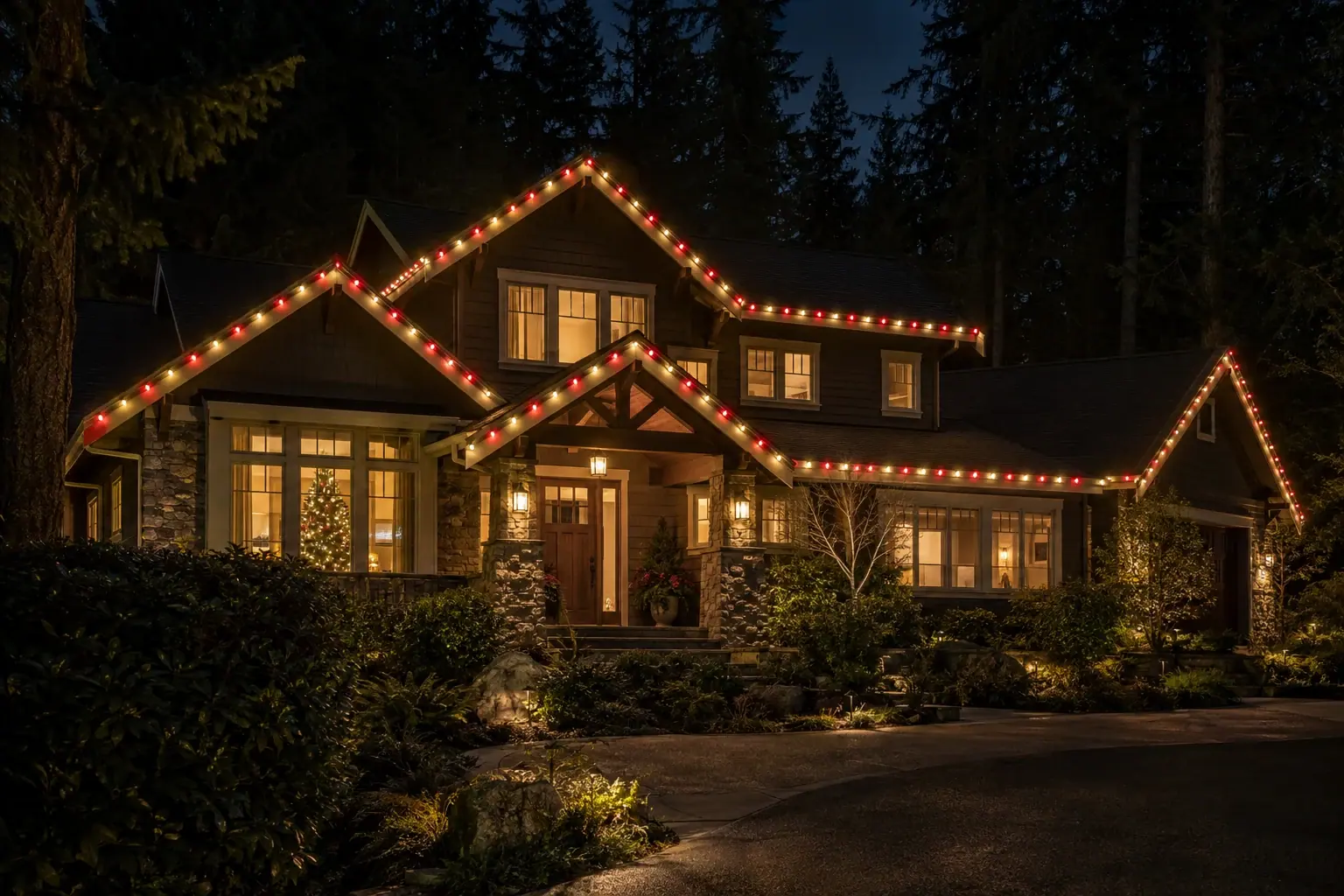
What a 150-foot roofline costs to run
One roofline, three ways: 150 feet of C9 bulbs at 12-inch spacing, the most common spacing for C9 rooflines, so 150 bulbs. The lights come on at sunset, about 4:30 p.m. in December in Vancouver, and go off at 11 p.m., the dusk-to-11 schedule our seasonal timer is set to. That's 6.5 hours a night.
| Bulbs | Roofline watts | kWh per 30 nights | Clark Public Utilities, 8.79¢ | PGE, about 20¢ | Cowlitz PUD, 7.66¢ |
|---|---|---|---|---|---|
| Incandescent C9, 7 W each | 1,050 W | 204.8 | $18.00 | $40.95 | $15.68 |
| Incandescent C9, 10 W each | 1,500 W | 292.5 | $25.71 | $58.50 | $22.41 |
| LED C9, 0.8 W each | 120 W | 23.4 | $2.06 | $4.68 | $1.79 |
kWh = bulbs × watts × 6.5 hours × 30 nights ÷ 1,000. Energy charges only: the basic monthly charge on your bill doesn't change. Bulb watts from Wintergreen's specifications; PGE's rate is the EIA's April–July 2026 average for its residential customers.
Leave the lights on from Thanksgiving weekend through New Year's Day, 36 nights this season, and multiply by 1.2. At 15-inch spacing (120 bulbs instead of 150) every figure drops by a fifth. A bigger house scales the same way: a 220-foot two-story is about half again as much.
One moment…
Checking availability.
How they look: warmth, color, sparkle and brightness
Warm white. Wintergreen rates its warm-white OptiCore LED C9 at 3000 K. The U.S. Energy Information Administration puts traditional incandescent light at about 2,500 to 3,500 K, with slightly orange tones, and says higher numbers look bluer. So a warm-white LED sits inside the incandescent range. The cool-white version of the same bulb is 6500 K, well outside it. If you're matching bulbs you already own, hold one lit sample next to them before you buy a box.
Color. An incandescent bulb gives off warm, yellowish light whatever color its glass is; a colored bulb gets its color from the coating on the glass. An LED makes colored light itself, which is why LED reds, greens and blues look more vivid. Wintergreen says the thick OptiCore lens walls fill the bulb with color.
Sparkle. LED C9 lenses come faceted or smooth. Wintergreen's faceted lens has a diamond-cut pattern that throws a halo of light; its smooth, opaque lens gives the traditional look. The bulbs in our seasonal service are faceted.
Brightness. Wintergreen rates the warm-white OptiCore C9 at 25.5 lumens. Most makers don't publish lumens for incandescent Christmas bulbs, so there's no like-for-like number. Compare them lit.
Heat, breakage and fire safety
An incandescent bulb makes light by heating a filament until it glows. An LED doesn't: Wintergreen says its LED bulbs stay cool to the touch, and ENERGY STAR says cool LED strings reduce the risk of fire.
Incandescent C7 and C9 bulbs are glass. OptiCore LED lenses are polycarbonate, which Wintergreen says is up to 200 times stronger than glass, and the Department of Energy calls LED strands sturdier and much less likely to burn out or break.
NFPA's holiday numbers cover decorations as a whole: fire departments respond to about 835 home fires a year that start with decorations other than Christmas trees, and a third of those are started by candles. Those figures don't break out outdoor roofline lights. The Consumer Product Safety Commission's rules for outdoor lights apply to both kinds:
- Use lights tested for safety by a nationally recognized testing laboratory, with a label showing they're certified for outdoor use.
- Plug outdoor lights into a GFCI-protected outlet or a portable GFCI.
- Check every set, new or old, for cracked sockets, frayed or bare wire and loose connections, and throw out damaged sets.
- Never string together more than three sets of incandescent lights, and never overload an outlet.
The bigger risk is usually the ladder. The CPSC counts about 160 Christmas decorating injuries a day during the holiday season, and nearly half involve falls.
How many sets can share one outlet
Two limits apply: the number of sets the maker allows end to end, and what the circuit behind the outlet can carry. Wintergreen's 25-bulb incandescent C9 set draws 175 W and allows 2 sets end to end. Its 25-bulb LED OptiCore C9 set draws 20 W and allows up to 1,000 feet or 960 W end to end.
A 15-amp household circuit carries 1,800 watts, and 1000Bulbs advises loading it to no more than 80 percent, 1,440 W. Anything else on the same circuit counts too.
| 150-foot roofline, 12-inch spacing | Incandescent C9, 7 W | LED C9, 0.8 W |
|---|---|---|
| 25-foot sets | 6 | 6 |
| Watts | 1,050 W | 120 W |
| Share of a 15-amp circuit's 1,440 W | 73% | 8% |
| Separate runs back to an outlet, at the maker's limit | 3 | 1 |
Set limits from Wintergreen's listings for its 25-bulb C9 sets. Check the tag or box on the sets you buy.
That's the practical difference on a house. An incandescent roofline needs several runs and uses most of a circuit before anything else is plugged in. A whole LED roofline runs from one outlet with room to spare.
Lifespan and replacement bulbs
Wintergreen rates its incandescent C9 and C7 bulbs at 3,000 hours on average and its OptiCore LED bulbs at 60,000. A season on the dusk-to-11 schedule, 36 nights at 6.5 hours, is about 234 hours of burn time.
On paper that's about 13 seasons for an incandescent bulb and more than 250 for an LED. Ratings are averages, not promises: some bulbs fail early, and glass breaks. Check the rating on what you buy, too; Wintergreen rates its own pre-made incandescent C9 set at 1,000 hours, about 4 seasons on this schedule.
Both kinds screw into the same E17 socket, and Wintergreen sells its C9 stringers for either, so switching to LED means new bulbs, not new cord.
Upfront cost against running cost
On September 26, 2026, Christmas Lights, Etc listed 25 clear 7-watt incandescent C9 bulbs at $9.00 and 25 warm-white OptiCore LED C9 bulbs at $32.99. For the 150-bulb roofline that's $54.00 against $197.94: LED costs about $144 more up front.
Over a 36-night season, LED saves about $19.13 on Clark Public Utilities, $43.52 on PGE and $16.67 on Cowlitz PUD. That pays back the difference in about 7½ seasons on Clark Public Utilities, 3½ on PGE and 8½ on Cowlitz PUD.
On Clark Public Utilities' low rate, energy alone is a slow payback, and the better reasons are cool bulbs, plastic lenses and one outlet instead of several. On PGE's rate, the savings cover the bulbs in a few seasons.
With our seasonal service you don't buy bulbs at all: the LED C9s are part of the price. We test, label and store them after the January takedown, ready to re-hang next season at the re-hang rate.
What we hang, and what it costs
Everything in our seasonal service:
- Commercial-grade Wintergreen faceted C9 LED bulbs, one color of your choice
- A clip on every bulb, no staples, no nails, no zip ties on gutters
- Timer or smart plug set for dusk to 11pm
- January takedown on the date agreed in your quote
- Testing, labeling and storage until next season
On average, Christmas lights run about $600; smaller homes often cost less, and the free measure gives your exact written quote. We charge by the foot: simple, honest, no hidden fees. Your written quote spells out everything before any work starts. Later seasons are a re-hang of the same layout. Colors we stock: warm white, pure white, red, green, blue, multicolor, red and white, red and green. See how each color looks on a house.
Want lights that stay up? Permanent roofline systems are LED too, and our guide to what permanent lighting costs to run does the same math for them. Permanent C9s come as C9 Classic, on clips, and C9 Track, in a channel. On average, permanent lights run about $3,000; smaller homes often cost less, and the free measure gives your exact written quote.
On average, Christmas lights run about $600; smaller homes often cost less, and the free measure gives your exact written quote.
Want C9s that stay up all year?
- C9 Classic: Full-color C9 bulbs on clips, the way Christmas lights have always been hung. Our lowest-cost permanent option.
- C9 Track: Classic C9 bulbs in a color-matched channel. Permanent, wire hidden, looks like Christmas lights should.
Priced by the foot · No hidden fees
Read next
- C7 vs C9 Christmas Lights: Which to Use on Your Roofline
- Christmas Light Installation Cost 2026: Vancouver & Portland
- Permanent Christmas Lights Electricity Cost per Month
- Permanent vs Seasonal Christmas Lights: Cost Over Time
- Christmas light installation: what's included and what it costs
Christmas light installation near you: Vancouver, Camas, Battle Ground, Woodland, Portland, Beaverton.
LED and incandescent questions
Do LED Christmas lights use less electricity?
How much does it cost to run Christmas lights?
Are LED Christmas lights brighter than incandescent?
Do warm-white LEDs look like old incandescent bulbs?
Can I put LED bulbs in my old C9 light strings?
What lights do you install?
Sources
The outside figures on this page come from these pages, read on September 26, 2026. Makers change specs and stores change prices, so check before you buy.
- Christmas Lights, Etc: C9 light strings and spools, spacing guide
- U.S. Naval Observatory: sun data for Vancouver, WA, Dec. 10, 2026 · sunset 4:27 p.m.; December 2026 sunsets run 4:27 to 4:37 p.m.
- Wintergreen Lighting: C9 clear transparent incandescent bulbs, 7 and 10 watt · 1.18 in., E17 base, 3,000 average hours
- Wintergreen Lighting: C9 warm white OptiCore LED bulbs, faceted · 0.8 W, 3000 K, 25.5 lumens, 60,000 average hours
- Clark Public Utilities: current electric and water rates · 8.79¢ per kWh, residential
- U.S. Energy Information Administration: Form EIA-861M sales and revenue by utility, 2026 · Portland General Electric residential revenue ÷ sales, April to July 2026: 19.6¢ to 20.2¢ per kWh
- Cowlitz PUD: Schedule 1 residential rate · 7.66¢ per kWh, effective Oct. 1, 2025
- U.S. Energy Information Administration: LED bulbs keep improving in efficiency and quality · Nov. 4, 2014; color temperature
- Wintergreen Lighting: C9 cool white OptiCore LED bulbs · 6500 K
- 1000Bulbs: C7 vs. C9 Christmas lights · May 9, 2025
- Wintergreen Lighting: C9 opaque (smooth) warm white OptiCore LED bulbs
- U.S. Department of Energy: How do holiday lights work? · Dec. 16, 2015
- ENERGY STAR: decorative light strings
- NFPA: winter holiday fire facts
- U.S. Consumer Product Safety Commission: holiday decorating release 18-054 · Dec. 6, 2017
- U.S. Consumer Product Safety Commission: holiday safety release 25-049 · Nov. 19, 2024
- Wintergreen Lighting: clear C9 lights on green wire, 25-bulb incandescent set · 175 W per set, 2 sets end to end, rated 1,000 hours
- Wintergreen Lighting: C9 warm white OptiCore commercial LED set, 25 bulbs · 20 W per set; up to 1,000 feet or 960 watts end to end
- Wintergreen Lighting: C7 clear transparent incandescent bulbs, 5 and 7 watt · 3,000 average hours
- Wintergreen Lighting: E17 intermediate light stringer, green wire · fits LED and incandescent bulbs
- Christmas Lights, Etc: C9 clear 7-watt incandescent bulbs, box of 25 · $9.00 on Sep. 26, 2026
- Christmas Lights, Etc: C9 warm white OptiCore LED bulbs, box of 25 · $32.99 on Sep. 26, 2026